


Battle Bay
4.118.91K Reviews
App Specs
- Version
- 5.4.5
- Updated On
- License
- Free
- Downloads
- 10,000,000+
- Developer
- Rovio Entertainment Oy
- Categories
- Action
- Platform
- Android
Screenshots
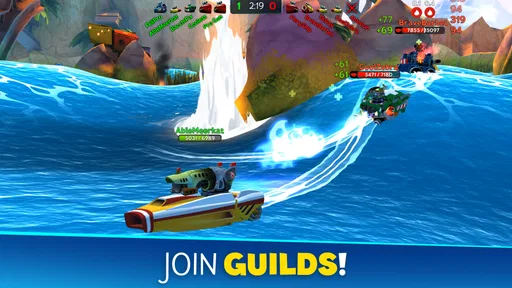
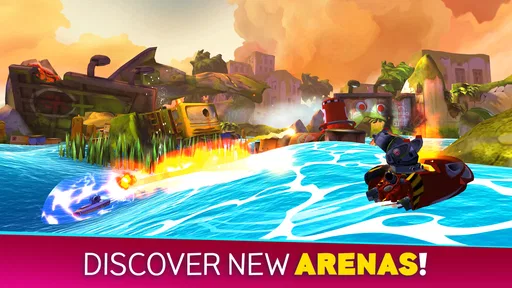
 Analysis by AppCompare
I approached Battle Bay as a decision rather than assuming that every mobile action game needs to be judged by the same standard. Rovio Entertainment Oy’s game puts you in a small boat and asks you to work with a team in real-time battles on the water. That simple setup matters: this is not a solo campaign built around clearing stages, and it is not a traditional shooter where individual aim tells the whole story. Your position, timing, target choice, and willingness to support teammates all affect the result.
My first impression was that the game is easy to understand but harder to play well. The controls are approachable enough for a quick match, yet the open water creates more decisions than the bright presentation initially suggests. You are constantly weighing movement against attacking, looking for cover against keeping a clear line of fire, and deciding whether to help a teammate or pursue a vulnerable opponent. The real appeal is the combination of short-session accessibility and team-dependent combat.
That combination also defines who should download it. If you want a mobile action game that can fill a few spare minutes and still reward practice, it is a strong candidate. If you prefer a carefully paced single-player adventure, a completely relaxed experience, or a battle where your personal performance matters more than team coordination, you may find the format frustrating. I would not choose it blindly; I would choose it because naval team combat sounds more interesting to you than the usual land-based alternatives.
What to consider before choosing a mobile battle game
When I choose a mobile battle game, I look beyond the first exciting match and ask what I’ll want to return to once its controls feel familiar. With Battle Bay, that means weighing the pleasure of steering through a live team fight against the patience needed when other players shape the outcome. I’d also consider whether short matches fit my routine without turning every spare moment into another round.
The match format changes the decision
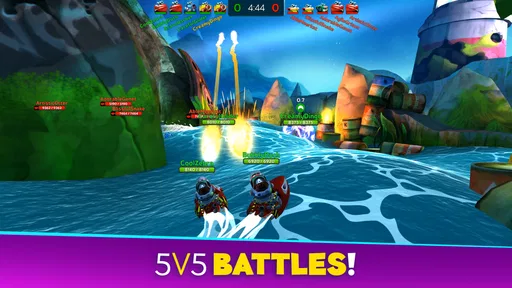
Before installing, I would ask myself one practical question: do I enjoy games where a match can go badly because another player makes a poor decision? In Battle Bay, that possibility is part of the design. The five-versus-five format makes cooperation important, but it also means that a good personal performance does not always guarantee a win. That can be exciting when a team recovers together and irritating when players scatter or ignore the main fight.
The water-based setting gives the action a different rhythm from a standard arena shooter. Movement is not just a way to reach the next location; it is part of survival. Turning too far can expose your side, drifting into an open area can make you an easy target, and rushing forward can leave teammates without support. I found that the game rewards players who watch the whole battlefield instead of staring only at the opponent directly in front of them.
This is also why the game works better for people who enjoy learning through repetition. Your first matches can feel busy because you are handling movement, aiming, enemy positions, and team behavior at once. With practice, those decisions become more readable. You start noticing when an opponent is overextending, when a teammate needs pressure taken off them, and when retreating is smarter than chasing a nearly defeated boat.
Worth Reading Before You Choose

EA SPORTS FC Mobile 26 Is a Bigger Football Game, but It Takes Time

Flipboard Shows What News Apps Must Do Beyond the Feed

Switching to Android Auto Means Rethinking Your Driving Routine

Google Calendar Makes a Crowded Week Easier to Manage

Ludo King Makes the Most of the Minutes Between Plans

Baby Panda World Brings Quick Play to Modern Phones, but Its Game Library Feels Busy
Accessibility versus long-term patience
The game is free to download, which makes trying it straightforward. It carries an Everyone 10+ content rating, so it is aimed at a broad audience while still being more action-focused than a purely casual puzzle game. It runs on Android from version 7.1 onward, making it accessible on a range of older devices, although actual comfort will naturally depend on the phone or tablet and how smoothly it handles real-time play.
Free access is useful, but it should not be confused with a completely frictionless experience. The game includes in-app purchases ranging from $0.99 to $99.99 per item. That price range is important when deciding whether it suits you or a younger player. I would treat the purchase option as part of the decision, not as an afterthought, especially if the device is shared with family members.
The current version is 5.4.5, and the game has been available since May 3, 2017. Its age can be viewed in two ways. On one hand, it has had time to establish its identity and attract a substantial player base. On the other, someone looking for the newest visual style or the most experimental mobile combat design may prefer a newer release. Battle Bay feels like a game with a defined personality rather than a brand-new idea trying to discover what it wants to be.
How I judge its moment-to-moment play
I pay attention to three things in a mobile action game: whether the controls make sense under pressure, whether a loss teaches me something, and whether the basic match remains enjoyable after the novelty wears off. Battle Bay performs best on the first and third points when you accept its team structure. The boat setting gives every engagement a clear physical context, and the action has enough movement and positioning to avoid feeling like a simple exchange of shots.
The second point depends on your attitude. A defeat can teach you that you moved too far ahead, chose the wrong target, or failed to read the wider fight. But not every loss will feel personally useful, because team games include variables outside your control. I recommend judging progress by your decisions rather than by the result of every single match. That mindset makes the experience much less stressful.
A realistic everyday session
Imagine having ten minutes before leaving for an appointment. Battle Bay fits that situation better than a game that needs a long uninterrupted campaign session. You can start a match, focus on a clear objective such as staying with your group or protecting a damaged teammate, and stop after the battle instead of committing to a large story chapter. I like that kind of use because it gives the session a beginning and an end without demanding a whole evening.
There is a catch: “quick to start” does not always mean “easy to stop.” If a match ends with a narrow defeat, you may want to play again immediately. That replay pull is common in competitive games, but it is worth recognizing if you are trying to control screen time. I would avoid opening it when I have only a minute or two, because the game is better enjoyed when I can finish a match without rushing away from it.
Where Battle Bay wins against familiar alternatives
The strongest reason I’d pick Battle Bay over a familiar arena shooter is not simply its nautical theme, but how that setting changes the decisions I make while a fight is unfolding. I’ll look at where its open-water movement creates meaningful choices, and where the five-player team format rewards restraint as much as aggression. That distinction matters if I want something fresh without learning an entirely different kind of action game.
The water setting has real gameplay value
Many mobile action games place players in familiar land arenas, corridors, or fantasy battlefields. Battle Bay’s boats are more than a visual theme. The water makes routes feel exposed and gives movement a sense of momentum. You are not simply stepping behind a wall and peeking around a corner; you are managing a vessel in an open space where approach angles and escape routes matter.
This creates a useful trade-off between aggression and safety. A direct attack can pressure an opponent, but it may also make your own boat predictable. Staying too far away can keep you alive while contributing very little. I found that the most satisfying decisions often happened between those extremes: moving close enough to support an attack, then changing direction before the opposing team could surround me.
That is a meaningful advantage over action games that reduce positioning to a few obvious lanes. The battlefield feels more fluid, and the best move is not always the one that produces immediate damage. Sometimes the smart play is to deny an enemy route, draw attention away from a teammate, or preserve your position for the next exchange.
Team awareness matters more than flashy solo play
The five-versus-five structure gives the game a social and tactical layer that many casual action titles do not emphasize. You do not need to be the player who deals the most damage to be useful. Holding a sensible position, joining a focus attack, or avoiding an unnecessary chase can help the group more than a reckless attempt to claim a single opponent.
One practical tip is to choose a simple team rule for yourself before each match. For example, I might decide to stay near the main group rather than roam alone. This reduces the number of decisions I have to make when the battle becomes chaotic. Another session might focus on protecting the most exposed teammate. These personal rules make improvement easier to notice because I can evaluate a specific behavior instead of vaguely asking why the match went wrong.
The trade-off is that teamwork can expose the weaknesses of random matchmaking. If players do not move together, the battlefield can quickly become uneven. The game is at its best when several people recognize the same threat at roughly the same time. It is less satisfying when everyone pursues separate targets and the match becomes a sequence of isolated defeats.
It offers depth without demanding a complicated presentation
The game’s approachable presentation helps it avoid the intimidating feel of a military simulator or a highly technical competitive title. You can understand the basic premise quickly: control a boat, fight opposing boats, and help your side win. That clarity is valuable on a phone, where a player may be switching between games or playing in short bursts.
At the same time, the naval setting creates room for advanced habits. I would pay attention to how often I enter a fight with a retreat route available, whether I am firing simply because a target is visible, and whether my movement helps or harms the team. These are small observations, but they turn a straightforward action game into a more thoughtful one.
Compared with a purely casual arcade game, Battle Bay asks for more concentration. Compared with a serious competitive shooter, it is easier to approach and less dependent on a familiar land-combat vocabulary. That middle position is its strongest category advantage. It can welcome a casual player while still giving a practiced player reasons to refine decisions.
Its established audience can make the game feel alive
The game has passed ten million installs and holds an average rating of 4.1 from around 427 thousand ratings, with around 19 thousand written reviews. Those figures suggest that it is not an obscure experiment with no visible audience. For a multiplayer game, that matters because the experience depends on finding other players and maintaining a sense of activity.
I would still avoid treating popularity as proof that every match will be ideal. A large audience can bring variety, including players with very different levels of experience and different ideas about teamwork. What the numbers do tell me is that the game has reached enough people to justify considering it as an active multiplayer option rather than a niche curiosity.
Where another type of game may suit you better
A game can be well made and still be a poor match for the way I want to spend a break. Battle Bay’s competitive rhythm and dependence on teammates may be less appealing than a game I can pause, play alone, or leave without wondering how the next match will go. I’ll explain the situations where I’d choose those alternatives instead, so the decision is about fit rather than a blanket judgment.
Choose a different option if you want a solo-first experience
Battle Bay is not my recommendation for someone who wants a self-contained story or a dependable offline routine. Its central appeal comes from opposing players, teammates, and the unpredictability of a shared match. If your ideal mobile game lets you pause freely, play at your own pace, or make progress without relying on a group, a single-player action adventure will probably fit better.
The same applies if you dislike repeated competitive rounds. Even when the controls are comfortable, the structure asks you to return to the same broad type of encounter and improve through practice. Players who prefer constant new environments, narrative surprises, or a clear sequence of handcrafted missions may feel that the match-based format becomes repetitive.
Choose a different option if losing to team decisions feels unfair
I enjoy team games, but I know they are not relaxing for everyone. In Battle Bay, a teammate who moves too far forward can create an opening for the opposing side. A player who ignores a nearby threat can force others to react late. These moments are not necessarily flaws in the controls; they are consequences of the format. Still, the emotional result is the same: you may lose after making several good choices.
If that situation makes you angry rather than curious, a solo action game or a mode built around individual performance would be a better use of your time. Battle Bay is most rewarding when I can separate “my decision was poor” from “the team situation collapsed.” That distinction is a skill in itself, and not everyone wants a game that requires it.
Consider the purchase model before committing
The free entry point is a clear advantage, but the in-app purchase range reaches from $0.99 to $99.99 per item. I would recommend setting a personal spending boundary before playing, rather than deciding in the middle of a frustrating losing streak. That simple step keeps the game in the category of entertainment instead of turning progress into an impulse purchase.
For parents, the Everyone 10+ rating is only one part of the decision. The competitive format and optional purchases deserve a separate conversation. For adults who are comfortable with free-to-play games, the sensible approach is to enjoy the core matches first and decide later whether any purchase genuinely improves the experience. I would not spend money merely to recover from a bad run of matches.
Device age and connection quality still matter
The minimum Android requirement of 7.1 makes the game potentially suitable for older devices, but minimum compatibility is not the same as ideal play. Real-time action is sensitive to stuttering, delayed input, and unstable connections. If your phone struggles with movement-heavy games or your usual connection is unreliable, the experience may feel worse than the game itself deserves.
This is one area where a less demanding offline alternative can be the better choice. Battle Bay’s appeal depends on responding at the right moment, so technical friction affects more than appearance. Before judging your own skill, I would make sure the game runs consistently and that the controls respond predictably on your device.
What switching to Battle Bay really involves
Trying Battle Bay is easy enough, but making it a regular part of my phone routine involves more than downloading it: I need to learn how its boats move, decide how much attention I can give a match, and set sensible boundaries around optional spending. I’ll focus on the practical adjustment rather than treating a first impression as a final verdict. That helps clarify what a newcomer should expect before settling in.
The learning cost is modest, but the habit cost is real
Moving from a standard mobile shooter to boat combat does not require abandoning everything you know. Aiming, target selection, and awareness still matter. The adjustment is that movement becomes more central, and the battlefield does not behave like a room with obvious corners. I needed time to stop treating the boat as a simple character skin and start using its position as part of the attack.
The more significant cost is learning to think in team terms. A player coming from a solo arcade game may initially chase the nearest opponent because that action feels productive. In Battle Bay, the better choice may be to stay with allies, wait for a safer angle, or retreat from a fight that cannot be won. That change can feel slower, but it is exactly what gives the game its identity.
A practical way to improve without turning play into homework
I recommend reviewing one decision after each match. Did I separate from the group too early? Did I keep firing at a target while ignoring a closer danger? Did I retreat soon enough? One question is enough. Trying to analyze everything at once makes a short mobile game feel like a training exercise, while a single focus produces useful progress.
Another helpful habit is to vary your role in a controlled way. Instead of copying the most aggressive player, try one match where your priority is survival and support. In another, look for moments to pressure an isolated opponent. This reveals whether you enjoy the wider tactical choices or only the direct action. It also prevents the common mistake of assuming that the boldest movement is always the most valuable.
I would also resist judging the game solely by early defeats. The controls may be understandable from the beginning, but reading the water, predicting movement, and coordinating with a group take longer. The game rewards familiarity with situations rather than memorization of a story. If you are willing to learn from several imperfect matches, the combat becomes more expressive.
How it compares with the usual alternatives
Against a conventional arena shooter, Battle Bay wins if you want a distinctive setting and more emphasis on movement through open space. The shooter is likely the better fit if you want immediate, familiar aiming and a stronger focus on individual reactions. Neither approach is automatically superior; they satisfy different kinds of action-game interest.
Against a casual arcade game, Battle Bay offers more room for tactical improvement but asks for more attention. The arcade alternative wins when you want instant feedback with minimal frustration. Against a single-player adventure, Battle Bay provides replayable human unpredictability instead of a planned sequence of encounters. The adventure wins when narrative progress and personal control matter more than competitive teamwork.
That comparison helped me place the game correctly. I would not describe it as a replacement for every action game on a phone. I would describe it as a focused choice for players who like the idea of piloting a boat in a coordinated team fight and want enough tactical tension to make repeated matches worthwhile.
My recommendation after weighing the trade-offs
I recommend Battle Bay to players who want a free action game with a clear multiplayer identity, enjoy learning through repeated matches, and can accept that teammates influence the outcome. The boat setting is not a superficial change from a normal arena: it changes how I approach distance, escape routes, support, and timing. That gives the game a recognizable character in a crowded mobile category.
I would especially suggest it for someone who has grown tired of ordinary land-based shooters but still wants quick competitive sessions. It also suits a player who likes setting personal goals, such as staying with the group, choosing safer engagements, or improving battlefield awareness one match at a time. Those goals create more lasting value than simply chasing a win every time.
I would skip it if you need a reliable solo game, dislike team-dependent results, or want a completely pressure-free way to relax. I would also be cautious if optional purchases tend to tempt you during competitive frustration. The free price makes experimentation easy, but the purchase range means sensible boundaries are part of using it well.
Rovio Entertainment Oy has built a game that is approachable at first glance but more nuanced once the boats begin moving and the teams separate. Its 10M+ installs show broad reach, while the 4.1 average indicates a generally positive reception without suggesting universal perfection. My final view is straightforward: download it when naval team combat sounds like the feature, not merely a novelty. Give it enough matches to learn the movement, judge your own decisions separately from your team’s result, and keep spending under control. If that sounds enjoyable, Battle Bay is worth trying; if it sounds like work, a solo or less competitive alternative will serve you better.
Pros
- Fast-paced real-time battles are easy to learn but difficult to master.
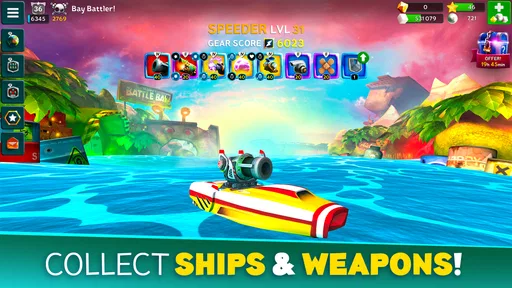
- Different boats and weapons support varied playstyles and team roles.
- Short matches make it convenient for quick gaming sessions.
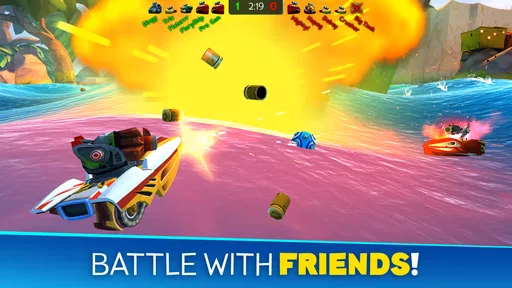
- Colorful 3D graphics and lively animations give battles plenty of character.
- Regular events and progression goals provide reasons to keep coming back.
Cons
- Matchmaking can feel uneven when experienced players face newer users.
- Upgrading boats and weapons may require considerable time or resources.
- Random teammates can make coordinated team play frustrating.
- The small arenas can become chaotic when several boats attack at once.
- Online play requires a stable connection and may consume noticeable mobile data.
FAQs for Battle Bay
What is Battle Bay and how does the gameplay work?
Battle Bay is a real-time multiplayer naval combat game in which you control a small warship and compete against other players in team-based battles. Before each match, you choose a boat, equip weapons and utilities, and select a suitable crew. During combat, positioning, aiming, movement, and teamwork are essential, because every vessel has different strengths, weaknesses, speed, and defensive capabilities.
Is Battle Bay free to download and play?
Yes, Battle Bay is generally free to download and play on supported mobile devices. However, it includes optional in-app purchases that can provide currencies, upgrades, cosmetic items, or progression-related advantages. You can enjoy matches without spending money, but advancing certain boats, weapons, and crew abilities may require patience and regular play if you choose not to make purchases.
Does Battle Bay require an internet connection?
Yes, Battle Bay is designed as an online multiplayer experience and requires a stable internet connection for its main gameplay features. Matches take place in real time against other players, so playing offline is not supported in the same way as a traditional single-player game. A weak or unstable connection can also cause lag, delayed controls, or disconnections.
Can beginners enjoy Battle Bay, or is it difficult to learn?
Beginners can enjoy Battle Bay, but the game has a learning curve that becomes noticeable after the introductory matches. Understanding each boat class, learning how weapon projectiles travel, and choosing the right moment to attack or retreat takes practice. Early battles help explain the basics, while later competition rewards players who communicate, coordinate with teammates, and customize their equipment carefully.
Are there different ships, weapons, and customization options in Battle Bay?
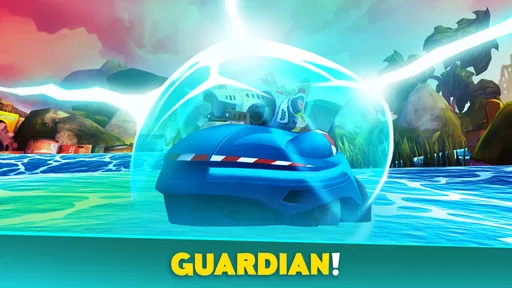
Yes, Battle Bay offers several boat types with distinct roles, including vessels focused on offense, defense, support, speed, or long-range attacks. You can equip different weapons and utility items, then improve your setup through progression and crew management. The best configuration depends on your preferred playstyle, although stronger equipment may take time to unlock or upgrade.


